The Hardest Question in Fuel Logistics Automation
Every operations leader evaluating automation asks the same question: What's the actual return?
Not a marketing number. Not a case study from a different industry. The return for their operation — their sites, their dispatchers, their fleet economics, their penalty exposure.
Most vendors answer this with a slide deck and a promise. We built a calculator.
The Navion Value Engine
The Navion Value Engine is a financial modeling tool that projects the operational and economic impact of KeepFill™ automation using inputs specific to your business.
You enter the numbers you already know:
- Number of sites you manage and your growth rate
- Dispatcher headcount and fully burdened labor cost
- Fleet economics — truck cost, loads per year, profitability per load
- Runout exposure — how often they happen, what they cost you
The Value Engine models what changes when KeepFill™ automates the upstream work of tank monitoring, consumption forecasting, and replenishment ordering. Every input is adjustable. Results update in real time.
What the Model Shows You
The output isn't a single number. It's a complete five-year financial picture across three views.
Financial Model
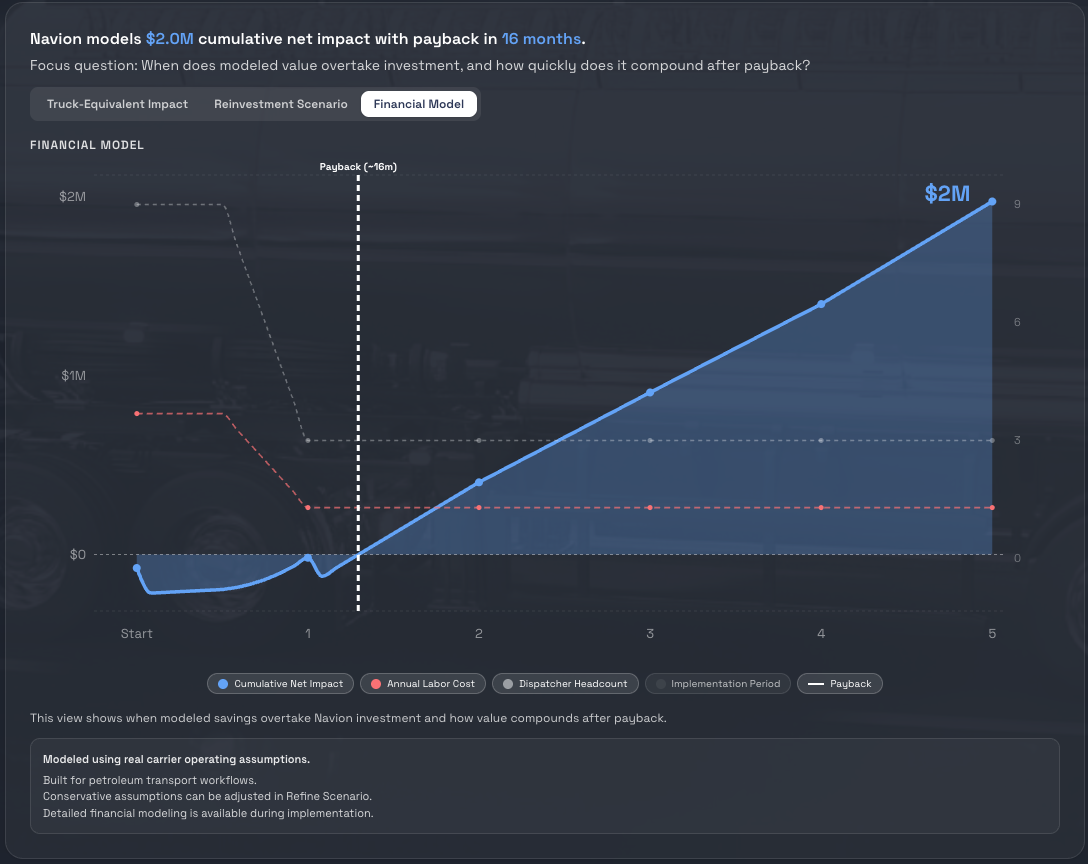
The model tracks cumulative net impact over your time horizon — labor savings from dispatcher redeployment and runout penalties avoided, net of Navion's implementation and subscription cost. The payback crossover is marked clearly. In this 600-site example, payback occurs at approximately 16 months.
Truck-Equivalent Impact
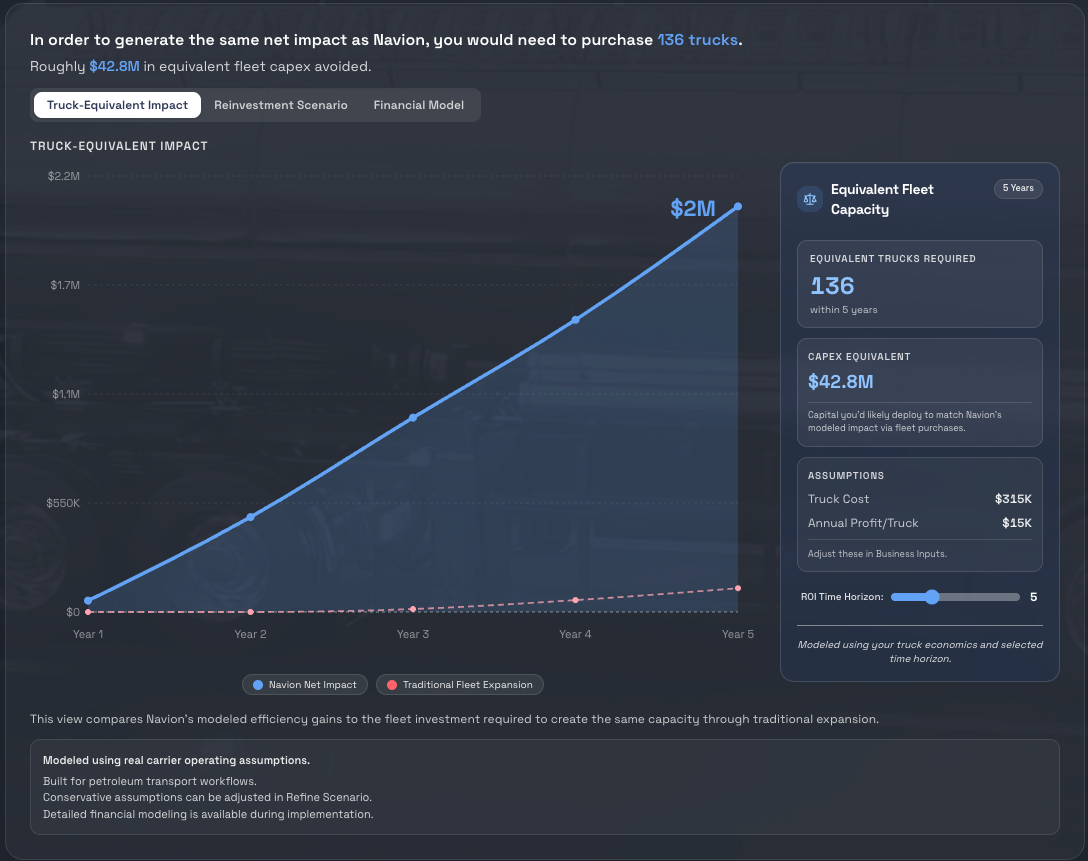
This is the comparison that reframes the conversation. The model calculates how many trucks you would need to purchase to generate the same net impact through traditional fleet expansion. In this example: 136 trucks. $42.8M in capital expenditure. 49x the cost of Navion.
Reinvestment Scenario
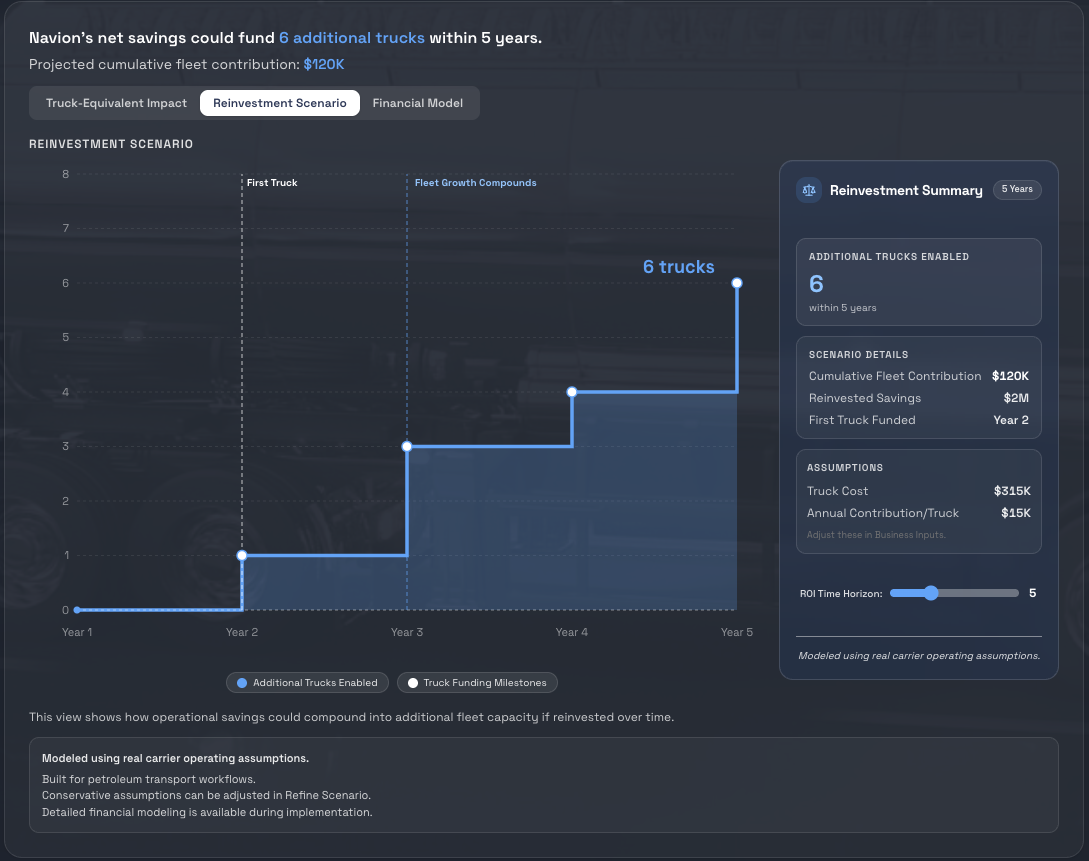
What if you redirected Navion's net savings back into fleet growth? The model projects how many additional trucks those savings could fund over five years. In this example, savings enable 6 additional trucks starting in Year 2, with fleet growth compounding from there.
Why We Built This
Automation vendors love to talk about "transformational" impact. But operations leaders don't buy transformation — they buy measurable outcomes with defensible assumptions.
The Value Engine exists because we believe the ROI case for KeepFill™ should be transparent, auditable, and specific to your operation. Every input is visible. Every assumption is adjustable. The model uses your numbers, not ours.
If the math doesn't work for your network, you'll see that too. We'd rather you know that upfront than discover it six months into a deployment.
Run Your Own Numbers
The Value Engine is live at navionlogistics.ai/roi. Enter your site count, dispatcher structure, and fleet economics, and see what KeepFill™ automation means for your operation.
No login required. No sales call to get access. Just the math.
See the Full Example
The PDF below shows the complete Navion Value Engine output for a 600-site network, including scenario inputs, financial model, fleet-equivalent comparison, and reinvestment projections.